
Chihuahua weight — is my Chihuahua too fat or too thin?
Chihuahua weight is one of the most important health indicators for this breed — and because their total body mass is so small, even half a pound in the wrong direction carries proportionally significant health consequences. A Chihuahua that is even one pound overweight is carrying a meaningful excess relative to their total frame. A Chihuahua that is underweight may be battling parasites, dental disease, or a metabolic condition that demands investigation. Understanding the correct Chihuahua weight range, how to assess body condition at home, and what to do when your dog falls outside the healthy zone is essential knowledge for every owner.
As AKC-registered Chihuahua breeders at Chihuvas, we monitor puppy weight from birth and discuss healthy weight management with every new family. This guide covers the AKC breed standard Chihuahua weight range, the body condition score method, signs of overweight and underweight dogs, and seven proven tips for maintaining a healthy weight throughout your Chihuahua’s life. Guidance draws on the AKC Chihuahua breed standard and the PDSA body condition score guidance.
How much should a Chihuahua weigh?
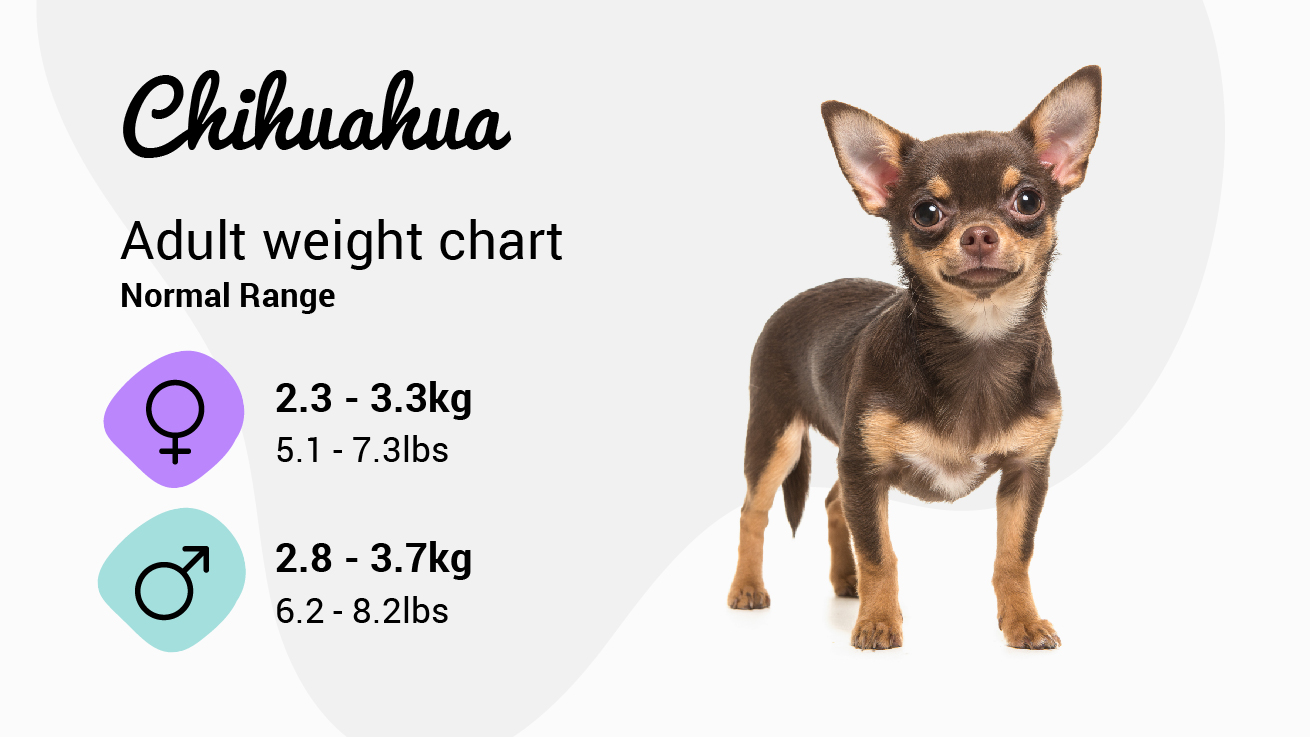
The AKC Chihuahua breed standard sets a maximum show weight of 6 pounds (2.72 kg). The ideal healthy adult Chihuahua weight range is generally accepted as 2 to 6 pounds (0.9 to 2.7 kg). This applies to both male and female Chihuahuas — unlike many breeds, there is minimal sex-based weight difference in Chihuahuas.
However, the breed standard weight is a show benchmark, not an absolute health threshold. Many perfectly healthy pet Chihuahuas with heavier bone structures or larger frames weigh above 6 pounds without being overweight. The most important measure of Chihuahua weight health is not a number on a scale but a body condition score — the assessment of body fat relative to the individual dog’s frame that tells you whether their current weight is appropriate for their specific build.
| Age | Typical weight range | Notes |
|---|---|---|
| 8 weeks | 0.5–1.0 lb (0.2–0.45 kg) | Varies significantly — smallest puppies need close monitoring |
| 3 months | 1.0–2.0 lb (0.45–0.9 kg) | Rapid growth phase |
| 6 months | 1.5–4.0 lb (0.7–1.8 kg) | Approaching adult size |
| 12 months | 2.0–5.5 lb (0.9–2.5 kg) | Near adult weight |
| Adult (18+ months) | 2–6 lb (0.9–2.7 kg) | AKC breed standard maximum 6 lb |
The body condition score — a better measure than weight alone
Body condition scoring (BCS) is the most accurate way to assess Chihuahua weight health — more reliable than scale weight alone because it accounts for the dog’s individual frame size and bone structure. Vets use a 1 to 9 scale; the ideal range for a Chihuahua is 4 to 5 out of 9. Here is how to assess your Chihuahua’s body condition at home:
- Rib check: run your fingers along your Chihuahua’s ribcage with light pressure. In an ideal-weight dog, you should feel each rib clearly under a thin layer of skin and fat — similar to how your knuckles feel under the skin of your hand. If ribs are difficult to find under a thick layer of fat, the dog is overweight. If ribs are clearly visible without touching, the dog may be underweight
- Waist check (from above): look down at your Chihuahua from above. A healthy-weight dog has a visible waist — a distinct narrowing between the ribcage and hips. No visible waist indicates excess fat deposits. An extremely exaggerated waist suggests underweight
- Abdominal tuck (from the side): look at your Chihuahua from the side. The abdomen should tuck up slightly behind the ribcage — not hang down level or sag below the chest
Signs your Chihuahua is overweight
Overweight is the most common Chihuahua weight problem in the UK and US — a study by the Association for Pet Obesity Prevention found that approximately 55% of dogs in the US are overweight or obese. Chihuahuas are particularly susceptible because their tiny caloric requirements mean even small amounts of extra food or treats result in proportionally significant weight gain. Signs your Chihuahua is carrying excess weight include:
- Ribs difficult or impossible to feel under a thick fat layer
- No visible waist when viewed from above
- Rounded or sagging abdomen when viewed from the side
- Reduced exercise tolerance — tiring quickly, reluctance to walk
- Panting heavily after minimal physical effort
- Reluctance or inability to jump onto furniture they previously managed
- Waddling gait rather than fluid movement
- Difficulty grooming themselves — reaching their back and tail
Signs your Chihuahua is underweight
An underweight Chihuahua weight is a more urgent concern than overweight because it almost always signals a medical cause that requires investigation. Signs your Chihuahua may be underweight:
- Ribs, spine, and hip bones clearly visible without touching
- No fat covering felt when gently pressing the ribs
- Very pronounced waist and obvious hip bones
- Muscle loss — particularly visible at the hindquarters and along the spine
- Dull, poor-quality coat
- Low energy and reduced activity levels
- Reduced appetite or difficulty eating
Underweight Chihuahuas need veterinary assessment to rule out intestinal parasites, dental disease (making eating painful), hypoglycaemia, malabsorption disorders, kidney disease, and other systemic conditions. Never attempt to address underweight with simply more food before investigating the cause.
Health consequences of incorrect Chihuahua weight
Because Chihuahuas are so small, Chihuahua weight problems — in either direction — have proportionally greater health consequences than in larger breeds:
| Condition | Overweight risk | Underweight risk |
|---|---|---|
| Heart disease | Significantly increased — excess weight strains the heart muscle | Cardiac muscle weakness from malnutrition |
| Joint problems | Worsens patellar luxation and arthritis dramatically | Muscle loss worsens joint instability |
| Tracheal collapse | Excess weight compresses the trachea | Low risk |
| Diabetes | Obesity is a primary risk factor | Hypoglycaemia risk increases |
| Lifespan | Obese dogs live significantly shorter lives | Malnutrition reduces longevity and immunity |
7 proven tips for healthy Chihuahua weight management
1. Measure every meal precisely
Free feeding — leaving food available at all times — is the most common cause of overweight Chihuahua weight problems. A Chihuahua needs only 40 to 80 calories per pound of body weight per day depending on activity level. This means a 4 lb Chihuahua needs approximately 160 to 320 calories daily — a very small quantity of food. Use a measuring cup or kitchen scale for every meal rather than eyeballing portions. A daily surplus of just 20 calories — less than one extra treat — translates to meaningful weight gain over weeks and months in such a small dog.
2. Choose a high-quality small breed food
Small breed dog foods are formulated with the higher calorie density and smaller kibble size appropriate for Chihuahuas. They also typically have higher protein content, which maintains muscle mass and keeps the dog feeling fuller between meals. Always check that the first ingredient is a named protein source (chicken, salmon, turkey) rather than a grain or filler. Avoid foods with excessive fillers — these provide poor nutritional value and lead to overconsumption to meet nutritional needs.
3. Limit treats to 10% of daily calories
Treats are one of the primary drivers of Chihuahua weight gain — not because any individual treat is large, but because their caloric contribution is rarely tracked alongside meals. Commercial dog treats can be surprisingly calorie-dense relative to a Chihuahua’s daily requirements. Limit treats to no more than 10% of daily caloric intake, use very small treat pieces (pea-sized) for training, and switch to low-calorie alternatives like small pieces of plain chicken, carrot, or cucumber for frequent reward situations.
4. Maintain consistent daily exercise
Exercise plays a dual role in Chihuahua weight management — it burns calories and maintains the muscle mass that drives metabolic rate. The 30 to 50 minutes of daily exercise recommended for adult Chihuahuas is achievable for most owners across two shorter walks. Even for senior Chihuahuas, two gentle daily walks maintain metabolic activity and prevent the muscle loss that compounds weight gain. See our Chihuahua exercise guide for the complete approach by age.
5. Weigh monthly and track the trend
Monthly home weighing is the single most effective early warning system for Chihuahua weight problems. A baby scale provides accurate measurements to the nearest ounce. Record the weight in a notes app or paper log alongside the date. Trend is more important than any single reading — a Chihuahua gradually gaining 0.2 lb per month will be significantly overweight within six months without a visible daily change. Catch the trend early and the intervention is simple. Miss it until the dog is obese and the intervention is significantly harder.
6. Reduce weight gradually if needed
If your Chihuahua needs to lose weight, the safe rate of loss is 1 to 2% of body weight per week — for a 6 lb dog, that is approximately 1 to 2 ounces per week. Faster weight loss risks muscle loss and nutritional deficiency. Reduce daily caloric intake by 10 to 20% from maintenance level, maintain or increase exercise, and reweigh monthly to confirm progress. Never starve a Chihuahua into weight loss — this causes serious metabolic and psychological harm. If in doubt, ask your vet to calculate a precise weight loss plan.
7. Address medical causes if diet and exercise do not work
If your Chihuahua is gaining weight despite appropriate feeding and regular exercise, or losing weight despite adequate food intake, a medical cause may be responsible. The most common medical drivers of unexpected Chihuahua weight gain include hypothyroidism and Cushing’s disease. Unexpected weight loss warrants investigation for intestinal parasites, dental disease, kidney disease, and cancer. A blood panel, urinalysis, and veterinary examination will identify or rule out these conditions. Browse our available puppies or get in touch with our team for any questions about your Chihuahua’s health.
When to see the vet about your Chihuahua’s weight
Always discuss Chihuahua weight with your vet at every routine check-up. Seek veterinary advice promptly if: your Chihuahua has gained or lost more than 0.5 lb in a month without dietary change, their body condition score suggests significant overweight or underweight, they are gaining weight despite appropriate feeding and exercise, they are losing weight despite eating normally, or their appetite has changed significantly in either direction. For more on Chihuahua health at every life stage, see our complete Chihuahua health problems guide and our senior Chihuahua care guide.
Common questions about Chihuahua weight
Find a healthy, well-nourished Chihuahua puppy from Chihuvas.
Every Chihuvas puppy is weight-monitored from birth and leaves at a healthy body condition score. AKC-registered, Michigan’s most trusted Chihuahua breeder.
View available puppies →