AKC Chihuahua breed standard — 9 proven traits of a perfect Chihuahua.
The AKC Chihuahua breed standard is one of the most detailed and precise breed descriptions in the American Kennel Club registry — a document that defines not just how a Chihuahua should look, but how it should move, carry itself, and express its character. As AKC-registered breeders at Chihuvas, we work to this standard with every litter we produce. Understanding it helps you recognise quality in a puppy, choose a reputable breeder, and appreciate what makes the Chihuahua such a remarkable and distinctive breed.
The official AKC Chihuahua breed standard was approved on September 11, 1990, and became effective October 30, 1990. It has remained largely unchanged since — a testament to how clearly it captures the essence of the breed. This guide breaks down every key element of the standard in plain language, from the iconic apple dome skull to the disqualifications that prevent a dog from competing in AKC conformation events. You can read the full AKC Chihuahua breed profile and the Chihuahua Club of America’s illustrated standard for the complete official documentation.
General appearance — what the standard says first
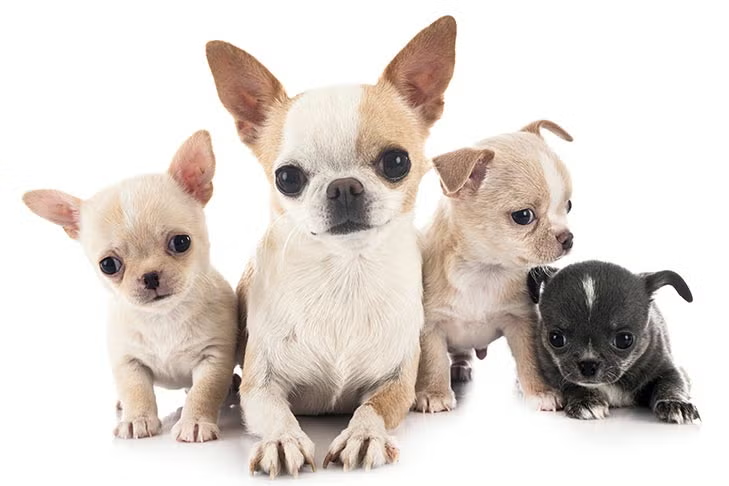
The AKC Chihuahua breed standard opens with a description of general appearance that perfectly captures the essence of the breed: a graceful, alert, swift-moving little dog with saucy expression, compact, and with terrier-like qualities of temperament. Every word of that sentence matters to a show judge — and to a breeder who takes the standard seriously.
Graceful suggests elegance of movement and proportion — not dumpy, not spindly, but balanced and refined. Alert describes the mental state the dog should always project — engaged, aware, and self-possessed. Saucy expression is one of the most charming elements of the standard — it acknowledges the Chihuahua’s famous combination of boldness, intelligence, and personality that shines through the face. And the terrier-like qualities reference the breed’s remarkable confidence and independence relative to its size.
Head — the apple dome skull
The head is the most distinctive and recognisable feature covered in the AKC Chihuahua breed standard. The skull should be well-rounded — what breeders and judges refer to as the “apple dome” — with or without a molera (a soft spot at the top of the skull, similar to a human fontanelle, which is acceptable in the standard). The stop — the angle where the muzzle meets the forehead — should be clearly defined, creating a distinct 90-degree angle between skull and muzzle.
The muzzle should be moderately short, slightly pointed, and broad enough at the base to give the face balance. The jaw should be strong with a level or scissors bite. The eyes are one of the most expressive features in the breed — the standard calls for full but not protruding eyes, well set apart, luminous dark or luminous ruby in colour, with light eyes permissible in blond or white-coloured dogs.
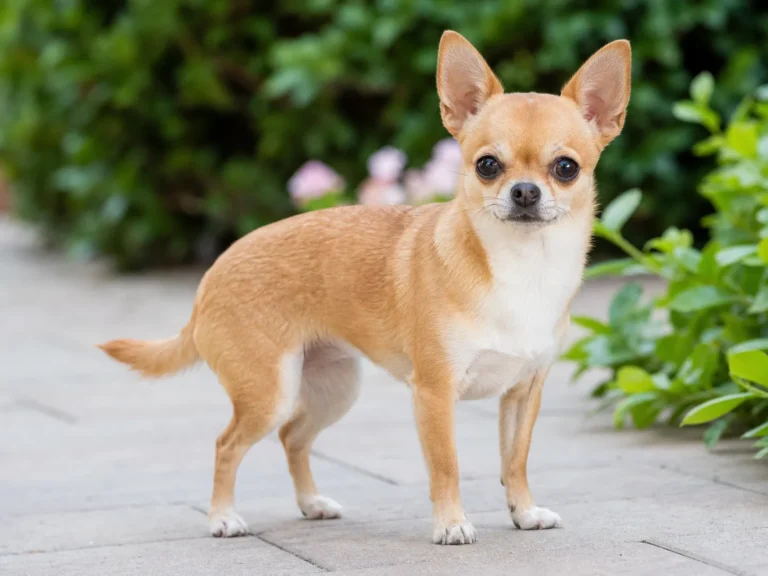
The ears are large and erect — held upright when the dog is alert, but flaring outward at approximately 45 degrees when at rest. This ear position gives the Chihuahua its characteristic breadth between the ears and contributes significantly to its alert, attentive expression. Ears that break down, lie flat, or are cropped are a disqualification under the AKC Chihuahua breed standard.
Body, proportion and weight
Weight is the most clearly defined — and most strictly enforced — element of the AKC Chihuahua breed standard. A Chihuahua must not exceed 6 pounds. This is not a preference or a guideline — it is a hard disqualification. Any dog over 6 pounds cannot compete in AKC conformation events, regardless of how exceptional its other qualities may be.
The body should be off-square in proportion — meaning slightly longer from shoulder to rump than it is tall at the withers. Shorter bodies are preferred in males. The back should be level, the chest broad and deep, and the ribs well-sprung. The neck is slightly arched and blends smoothly into the shoulders. The tail should be moderately long, carried in a sickle shape either up or out to the side — never tucked between the legs, which signals fear or poor temperament.
The legs should be straight and strongly boned relative to the dog’s size, with small, dainty feet. Dewclaws may be removed. The overall impression should be one of compactness and substance — a small dog that appears well-built and capable rather than fragile or toy-like despite its diminutive size.
Coat varieties — smooth coat and long coat
The AKC Chihuahua breed standard recognises two distinct coat varieties, and both are judged to the same overall standard with specific requirements for each coat type.
Smooth coat Chihuahua
The smooth coat should be of soft texture, close and glossy. Heavier coats with undercoats are permissible. A ruff on the neck is preferred, and the coat should be distributed evenly across the body. The head and ears typically have a more scanty coat than the body. The tail should carry a fuller coat, with a plume preferred. Smooth coat Chihuahuas require minimal grooming — a weekly brush and occasional bath is sufficient for most.
Long coat Chihuahua
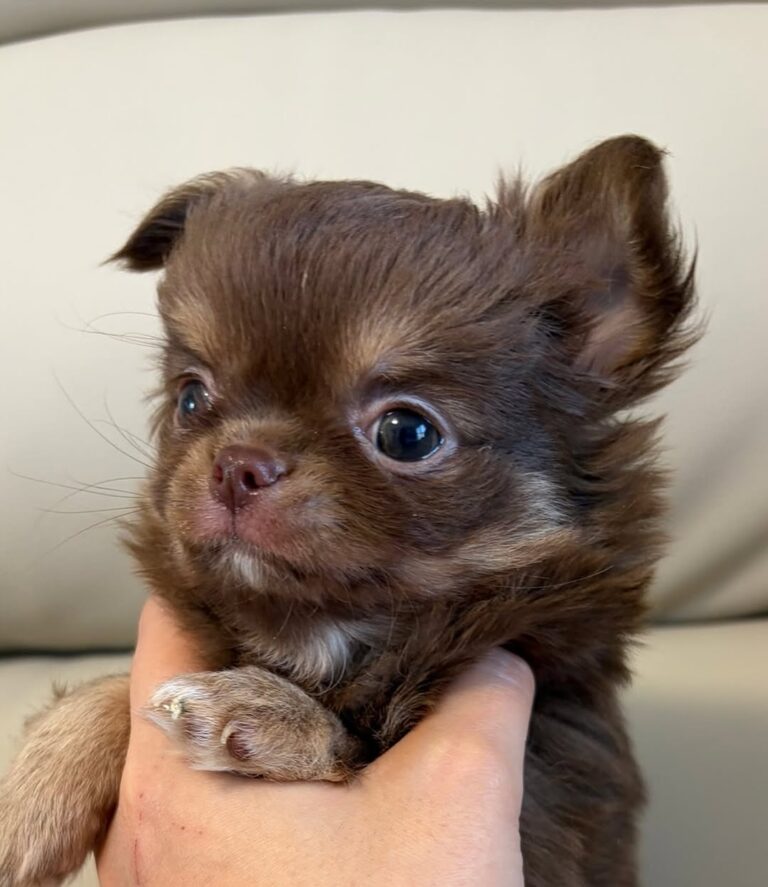
The long coat should have a soft texture, either flat or slightly wavy. An undercoat is preferred. The ears should be fringed, and the tail should be full and long — described in the standard as “a plume.” Feathering on the legs and feet, “pants” on the hind legs, and a large ruff on the neck are all desired and preferred in long coat Chihuahuas. The only disqualification specific to the long coat variety is a coat too thin that resembles bareness. Long coats require more regular brushing to prevent tangles and maintain the flowing appearance the standard describes.
Colour — any colour accepted
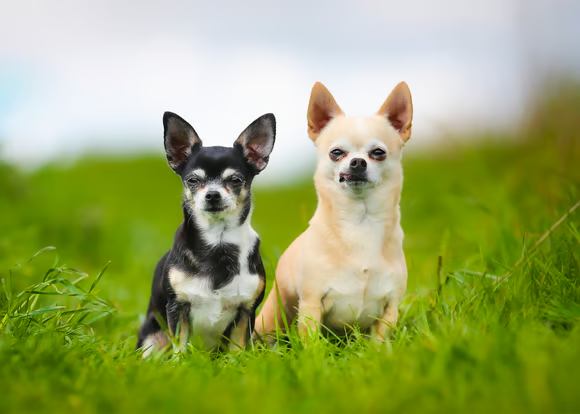
Colour is one of the most permissive elements of the AKC Chihuahua breed standard. The standard simply states: “Any color — Solid, marked or splashed.” This means Chihuahuas can be shown and bred in any colour or colour combination — from solid black, white, fawn, chocolate, cream, and blue, to marked, sable, brindle, and parti-colour combinations. No colour is preferred over another, and no colour is a disqualification.
At Chihuvas, our puppies come in a wide variety of colours reflecting this openness in the standard. What matters in breeding decisions is health, structure, and temperament — not coat colour. Browse our available puppies to see the variety of colours in our current litters.
Gait and movement — swift and firm
Movement is one of the most revealing tests of structural correctness under the AKC Chihuahua breed standard. The standard requires the Chihuahua to move swiftly with a firm, sturdy action — with good reach in front equal to the drive from the rear. The dog should carry its head high when moving, with the topline remaining firm and the backline level throughout.
From the rear, the hocks should remain parallel to each other, and the footfall of the rear legs should follow directly behind the forelegs. As speed increases, both front and rear legs naturally tend to converge slightly toward the dog’s central line of gravity — this is normal and expected. What judges look for is power, balance, and efficiency of movement — a dog that covers ground purposefully rather than mincing or padding.
Poor movement — crossing over, weaving, paddling, or a roached back when moving — indicates structural faults that affect the dog’s soundness and would count against it heavily in a show ring under the AKC Chihuahua breed standard.
Temperament — alert with terrier-like qualities
The temperament section of the AKC Chihuahua breed standard is brief but precise: “Alert, projecting the terrier-like attitudes of self importance, confidence, self-reliance.” For a breed that weighs under 6 pounds, this is a remarkable description — and anyone who has spent time with Chihuahuas will immediately recognise its accuracy.
Chihuahuas are genuinely self-assured dogs. They do not have the instinct for submission that many larger breeds display. They approach the world with curiosity and boldness, form intense bonds with their primary person, and will defend their territory and their family with conviction that belies their size. A well-bred Chihuahua from sound lines should never be timid, fearful, or aggressive without cause — these traits indicate either poor genetics or inadequate socialisation, both of which are departures from the standard.
At Chihuvas, temperament is not an afterthought in our breeding programme — it is central to everything we do. We socialise every puppy from birth, expose them to varied environments and people, and select only dogs with the confident, stable temperament the AKC Chihuahua breed standard describes.
Show disqualifications under the AKC standard
The following traits disqualify a Chihuahua from competing in AKC conformation events under the official breed standard:
- Any dog over 6 pounds in weight — the most commonly enforced disqualification. Dogs are weighed at shows and any dog exceeding 6 pounds is immediately disqualified
- Broken down or cropped ears — ears that do not stand erect, or that have been surgically altered, are disqualifying
- Cropped tail or bobtail — the tail must be natural and of appropriate length. A docked or naturally short bobtail is a disqualification
- Long coat specific: too thin a coat resembling bareness — a long coat Chihuahua must have sufficient coat density. A coat so sparse it appears bare is disqualifying in that variety
It is important to note that disqualifications for showing do not mean a dog is unhealthy or an unsuitable pet. A Chihuahua over 6 pounds can be a wonderful companion — it simply cannot compete in AKC conformation events. As AKC-registered breeders, we breed to the standard but we also celebrate every puppy for the individual they are, regardless of whether they are show or pet quality.
Why the AKC Chihuahua breed standard matters to buyers
Even if you have no interest in dog shows, the AKC Chihuahua breed standard matters when choosing a puppy. Breeders who work to the standard — like Chihuvas — prioritise the structural soundness, temperament, and genetic health that the standard is designed to preserve. A Chihuahua bred to standard is more likely to have the correct head structure that reduces respiratory issues, the proper body proportion that supports joint health, and the stable temperament that makes the breed such a rewarding companion.
Breeders who ignore the standard — particularly the weight limit and temperament requirements — are often prioritising novelty or profit over the long-term health and wellbeing of the breed. Extremely small “teacup” Chihuahuas, for example, are not a recognised variety under the AKC Chihuahua breed standard and are often associated with significant health risks. A well-bred Chihuahua between 2 and 6 pounds from health-tested parents will almost always be a healthier, longer-lived companion than an undersized dog from unverified lines.
Common questions about the AKC Chihuahua breed standard
Looking for an AKC-standard Chihuahua puppy?
At Chihuvas, every puppy is bred to the AKC Chihuahua breed standard — for structure, temperament, and health. Michigan’s most trusted AKC-registered Chihuahua breeder.
View available puppies →