Chihuahuas and other pets — 7 proven tips for a peaceful home.
Chihuahuas and other pets can absolutely share a home successfully — but the combination requires more careful management than introducing two similar-sized, temperamentally compatible breeds. The Chihuahua’s most distinctive characteristic in a multi-pet household is also its most entertaining one: complete unawareness of its own tiny size. A Chihuahua will challenge a Labrador without hesitation, announce itself to a cat with the confidence of a much larger dog, and generally behave as though the world owes it deference regardless of who else is in it. Managing this boldness alongside the genuine physical vulnerabilities of a 2 to 6-pound dog is the heart of making Chihuahuas and other pets work.
As AKC-registered Chihuahua breeders at Chihuvas, many of our puppies go into multi-pet households and we counsel those families carefully on introductions. This guide covers all the major Chihuahuas and other pets combinations — with other dogs, cats, and small animals — alongside the seven proven tips that make multi-pet households work. The AKC guide to introducing dogs and the PDSA guide to introducing pets provide additional expert context.
Chihuahuas and other dogs
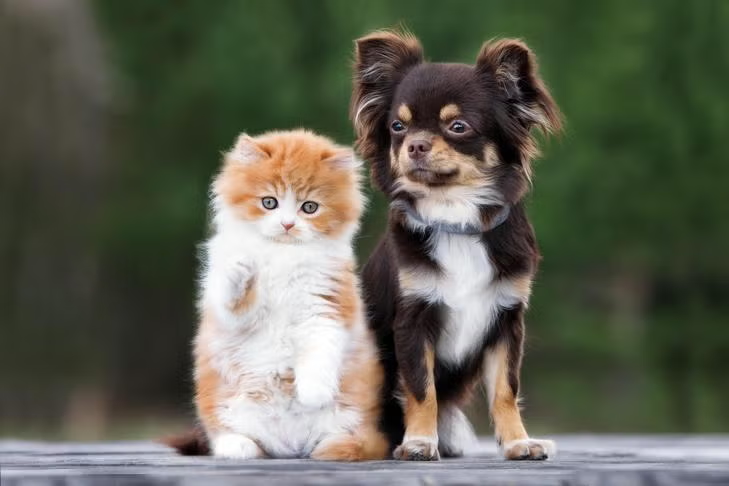
Chihuahuas and other dogs can live together very happily — the most compatible pairings tend to be with other Chihuahuas, similarly small breeds (Pomeranians, Yorkshire Terriers, Maltese), or calm, gentle medium-sized breeds with low prey drive. Chihuahuas that have been well-socialised from puppyhood with other dogs are significantly more comfortable in multi-dog households than those who encounter other dogs for the first time as adults.
The most important factors in successful Chihuahuas and other dogs pairings are compatible energy levels, individual temperament, and the quality of the introduction. Two high-energy dogs can work well together — but a very anxious Chihuahua paired with a boisterous, bouncy larger breed creates ongoing stress for the smaller dog. When considering adding a dog to a Chihuahua household, the temperament and play style of the prospective companion matters more than breed alone.
Chihuahuas and large dogs — the size problem
The most significant risk in Chihuahuas and other pets combinations involving large dogs is not intentional aggression — it is accidental injury. A large dog playing enthusiastically can injure or kill a Chihuahua without any aggressive intent. A paw placed on a Chihuahua, a vigorous play bounce, or a collision during a run in the garden can cause catastrophic injury to a dog weighing 3 pounds.
This does not mean Chihuahuas and large dogs cannot share a home — many do successfully. It means the management requirements are higher and must be consistent. Supervised interactions always. Separate feeding areas to prevent resource competition. The Chihuahua always having a retreat the large dog cannot access — a crate, a room with a small-dog-only opening, or elevated furniture. And owners who understand that their large dog’s friendly enthusiasm can be as dangerous to a small dog as aggression.
Chihuahuas and cats
Chihuahuas and cats can be one of the most successful multi-pet combinations — particularly when both are young, the introduction is gradual, and the cat always has the ability to create distance. The Chihuahua’s small size actually helps here: cats are rarely intimidated by an animal their own size, and many cats treat Chihuahuas with the same confident indifference they show toward other cats.
The most important requirements for successful Chihuahuas and cats coexistence are: the cat must always have elevated escape routes the Chihuahua cannot follow, the Chihuahua must never be allowed to chase or corner the cat (even in play), and the introduction must proceed slowly through the scent-swapping and visual barrier stages before any free interaction is allowed. A cat that has been chased repeatedly by a dog will never fully relax in that household — preventing the chase habit from ever forming is essential.
Cats and Chihuahuas that have been raised together from young ages — ideally both introduced as young animals simultaneously — tend to form the closest bonds and the most naturally harmonious relationships. Many households describe their resident Chihuahua and cat sleeping together, grooming each other, and playing cooperatively after a successful gradual introduction.
Chihuahuas and small animals
Chihuahuas and small animals — rabbits, guinea pigs, hamsters, birds, and similar — require the most careful management of any multi-pet combination. Despite their small size, Chihuahuas retain prey drive instincts that can be triggered by the movement, scent, and behaviour of small animals. A Chihuahua that appears calm near a rabbit in a hutch can become dangerously predatory if that rabbit is brought out and moves unpredictably.
Small animals in households with Chihuahuas should always be housed in secure enclosures the dog cannot access independently. Free interaction between a Chihuahua and a small animal should always be supervised by a responsible adult who can intervene immediately. Never leave them unattended together regardless of how many safe encounters have occurred previously — prey drive can be triggered suddenly by unexpected movement.
7 proven tips for Chihuahuas and other pets
1. Start with scent swapping before any physical meeting
The most important foundation for Chihuahuas and other pets introductions is scent familiarisation before visual or physical contact. Swap bedding or worn items between the animals’ living areas for several days. Allow each animal to investigate the other’s scent in their own space and at their own pace. By the time of the first physical meeting, both animals already know each other exists — reducing the novelty and anxiety of the encounter significantly.
2. Introduce dogs on neutral territory
First meetings between Chihuahuas and other dogs should always happen on neutral territory — not in either dog’s home or garden, where territorial instincts are heightened. A park, a quiet street, or a friend’s garden works well. Both dogs should be on lead but not restrained so tightly that tension is communicated down the lead. Allow brief parallel walking before permitting direct interaction. Keep the first meeting short, positive, and calm.
3. Never force the interaction
Forcing a Chihuahua toward another animal before it is ready — or holding them together to “get it over with” — is one of the fastest ways to create lasting fear and aggression. Every positive interaction between Chihuahuas and other pets should be one both animals chose to participate in. If your Chihuahua moves away from the other animal, allow that retreat. If the other animal retreats, allow it. Voluntary interaction progresses faster and produces more durable positive relationships than forced contact.
4. Always supervise and never leave unsupervised early on
For all Chihuahuas and other pets combinations, particularly in the first weeks and months, every interaction requires supervision. Unsupervised access between a Chihuahua and any other animal before trust is thoroughly established risks incidents that can permanently damage the relationship — or injure one of the animals. Build to unsupervised time gradually and only when you are genuinely confident in the stability of the relationship.
5. Manage resources carefully
Resource guarding between Chihuahuas and other pets is a common source of conflict in multi-pet households. Feed all animals separately, in their own spaces, without the other watching. Provide multiple water bowls. Give high-value treats and chews only when animals are separated. Remove toys and food items before joint time in shared spaces. Removing the competition removes the most common trigger for inter-pet conflict.
6. Give the Chihuahua a small-dog-only retreat
In households with larger dogs or cats, providing the Chihuahua with a space only they can access — a crate, a room with a small dog door, or a baby-gated area — gives them genuine agency over their environment. A Chihuahua that can retreat when overwhelmed by other animals is a significantly calmer and more confident dog than one that must share all space at all times. This retreat is particularly important for managing Chihuahuas and other pets in households with energetic larger dogs.
7. Reward all calm, positive interactions generously
Every calm, positive interaction between your Chihuahua and other pets is worth marking and rewarding. High-value treats, calm praise, and gentle fuss given immediately after calm behaviour around other animals accelerates the positive association faster than any other technique. The animals learn that the presence of the other predicts good things — and this positive association compounds with each rewarded interaction into a genuine comfort and tolerance that eventually becomes the default.
Should you get two Chihuahuas?
One of the most successful multi-pet combinations for Chihuahuas and other pets is simply two Chihuahuas. Two dogs of the same breed and similar size share a natural compatibility — comparable energy levels, similar communication styles, and similar physical robustness. Two Chihuahuas provide each other with companionship, play, warmth, and comfort throughout the day — particularly valuable for owners who work outside the home.
The considerations for two Chihuahuas include: introducing them carefully using the same staged process as any other dog introduction, ensuring both receive adequate individual attention from their owner, providing separate feeding stations, and being aware that closely bonded pairs can sometimes develop separation anxiety if one is away. At Chihuvas, we match families considering a second Chihuahua carefully — contact us through our get in touch page to discuss what works best for your household. Browse our available puppies to see our current litters.
Common questions — Chihuahuas and other pets
Find the perfect Chihuahua companion at Chihuvas.
Our AKC-registered puppies are socialised from birth — confident, adaptable, and ready for multi-pet households. Michigan’s most trusted Chihuahua breeder.
View available puppies →