
Chihuahua collapsed trachea — 6 warning signs every owner should know.
Chihuahua collapsed trachea is one of the most common — and most misunderstood — health conditions in the breed. The name sounds terrifying, and the first time you hear the distinctive honking cough that gives it away, you may fear the worst.
The reality is more manageable than the name suggests. Most chihuahuas with collapsed trachea live full, comfortable lives with the right care. This guide explains exactly what chihuahua collapsed trachea is, the warning signs to watch for, what causes it, and how it is treated. The medical information here is consistent with veterinary guidance from the American Kennel Club.
Chihuahua collapsed trachea — what it actually is
The trachea, or windpipe, is normally held open by a series of rigid cartilage rings that keep the airway rigid and open with every breath. In chihuahua collapsed trachea, these cartilage rings weaken over time and begin to flatten.
Instead of staying round and open, the trachea partially collapses inward during breathing, narrowing the airway and making it harder for air to pass through. This is a progressive condition, meaning it typically worsens gradually over months or years rather than appearing suddenly.
Chihuahua collapsed trachea is disproportionately common in this breed because of their small, narrow airways. A structure that would barely be noticed in a larger dog’s wider windpipe becomes clinically significant in the chihuahua’s proportionally tiny trachea.
Toy and small breeds as a category are far more prone to this condition than medium or large dogs.
Chihuahua collapsed trachea — the 6 warning signs
1. The honking cough
This is the hallmark sign of chihuahua collapsed trachea. The cough is dry, harsh, and has been consistently described by owners and vets alike as sounding like a goose honking. It is distinct from a normal wet cough and different from the snorting sound of reverse sneezing.
2. Cough triggered by excitement or exercise
Increased breathing rate during excitement or physical activity puts more pressure on the already-weakened trachea. If your chihuahua’s cough reliably appears during play, greetings, or walks, this pattern strongly suggests collapsed trachea rather than a random cough.
3. Cough triggered by collar pressure
Pulling against a collar puts direct pressure on the trachea. In a chihuahua with collapsed trachea, this pressure can trigger an immediate coughing episode. This is one of the strongest arguments for switching to a harness — collar pressure on a compromised airway can worsen both symptoms and long-term damage.
4. Worse in heat and humidity
Hot, humid weather makes breathing more laboured for every dog, but a chihuahua with a narrowed airway feels this more acutely. Increased panting in heat puts additional strain on an already compromised trachea, often triggering coughing episodes.
5. Cough during eating or drinking
The act of swallowing can put transient pressure on the trachea. Coughing episodes shortly after eating or drinking are a common pattern in chihuahua collapsed trachea, though this can also overlap with other conditions, so it is not diagnostic on its own.
6. Fatigue or exercise intolerance
As the condition progresses, some chihuahuas show reduced stamina, tiring more quickly on walks or during play than they used to. This sign is more subtle and often develops gradually, making it easy for owners to attribute to normal aging rather than the tracheal condition.
Seek immediate veterinary care if your chihuahua shows blue or purple gums or tongue, collapses or faints, struggles to breathe even at rest, or makes a continuous distressed wheezing sound that does not resolve.
These signs indicate a severe episode requiring emergency treatment, not routine management.
Chihuahua collapsed trachea — what causes it
The exact cause of chihuahua collapsed trachea is not fully understood, but veterinary research points to several contributing factors working together rather than a single cause.
- Congenital weakness: Many chihuahuas are believed to have an inherited weakness in the tracheal cartilage that predisposes them to the condition, which then worsens with age.
- Obesity: Excess weight puts additional pressure on the airway and chest cavity, accelerating the progression of tracheal collapse. Weight management is one of the most effective interventions available.
- Collar use: Repeated pressure on the trachea from collar pulling over years may contribute to or worsen tracheal weakening. This is why harnesses are strongly recommended for the breed.
- Chronic irritation: Long-term exposure to smoke, strong chemical fumes, or airborne allergens may contribute to airway inflammation that compounds the structural weakness.
- Age: Chihuahua collapsed trachea is most commonly diagnosed in dogs over 5 years old, with incidence increasing significantly in senior dogs.
Chihuahua collapsed trachea — how it’s diagnosed
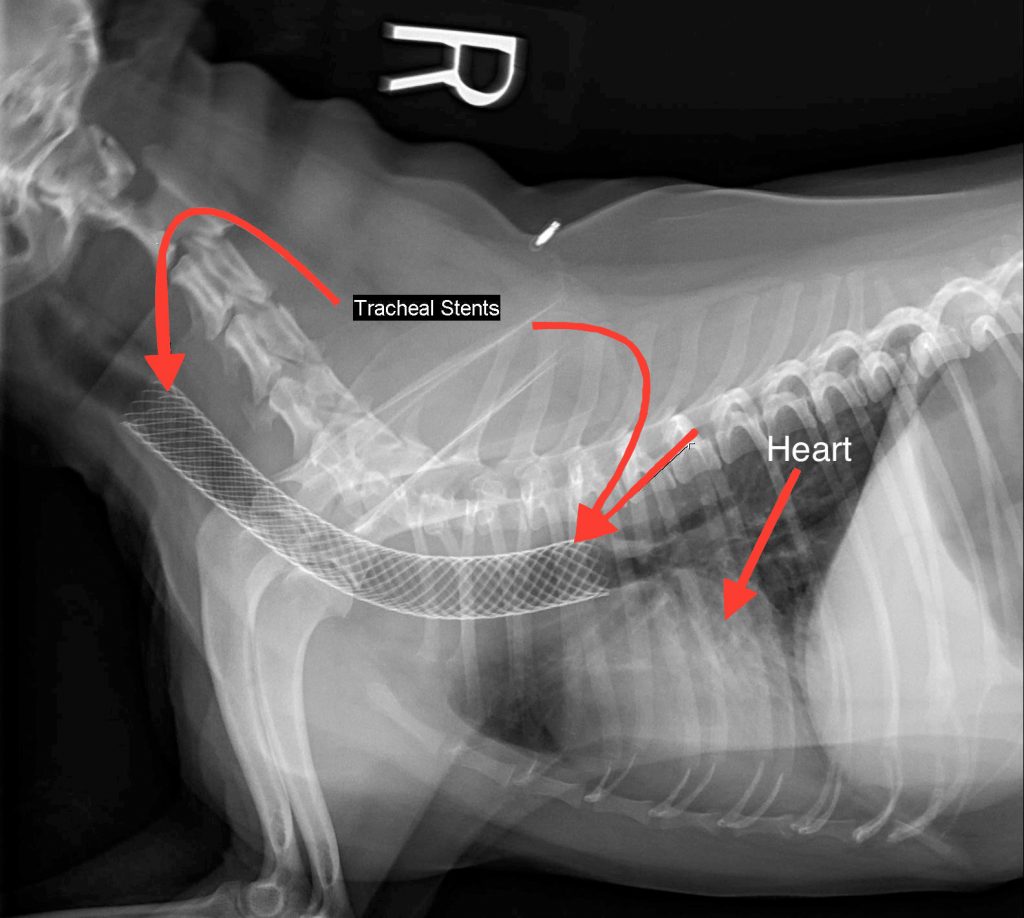
If your vet suspects chihuahua collapsed trachea based on the honking cough and trigger pattern, they will typically start with a physical examination, gently palpating the trachea to check for sensitivity or an abnormal feel. Chest X-rays can often reveal the collapse, particularly if timed during both inhalation and exhalation.
Fluoroscopy — a moving X-ray that captures the trachea in real time during breathing — provides the most accurate diagnosis because it can catch the collapse in action rather than relying on a still image. In some cases, bronchoscopy (a small camera inserted into the airway) may be used to directly visualise the degree of collapse and rule out other causes.
| Grade | Severity | Typical management |
|---|---|---|
| Grade I | Mild — 25% narrowing | Weight management, harness, monitoring |
| Grade II | Moderate — 50% narrowing | Medication, weight control, trigger avoidance |
| Grade III | Severe — 75% narrowing | Intensive medical management, surgery considered |
| Grade IV | Complete — near-total collapse | Surgical intervention usually required |
Chihuahua collapsed trachea — treatment and management
Weight management
Excess weight is one of the most significant, controllable factors in chihuahua collapsed trachea severity. Even a small amount of weight loss in an overweight chihuahua can noticeably reduce coughing frequency and severity by reducing pressure on the airway and chest.
Switch to a harness
This is the single most important lifestyle change for a chihuahua with collapsed trachea. A well-fitted harness redirects all leash pressure to the chest and shoulders, completely eliminating pressure on the vulnerable trachea. Collars should be avoided entirely once the condition is diagnosed.
Medication
Cough suppressants reduce the frequency and severity of coughing episodes, breaking the cycle of irritation that each cough causes. Anti-inflammatory medication reduces swelling in the airway tissue. Bronchodilators may be prescribed to help open the airway. Sedatives are sometimes used short-term during high-stress situations that trigger severe episodes.
Environmental management
Keep your chihuahua cool in hot weather, avoid smoke and strong chemical fumes, minimise exposure to high-excitement situations that trigger episodes, and use a humidifier in dry conditions since dry air can irritate an already sensitive airway.
Surgical options
For severe cases (Grade III–IV) that do not respond adequately to medical management, surgical intervention may be recommended. Tracheal ring prosthesis involves placing external rings around the trachea to hold it open. Tracheal stenting places an internal support device inside the airway.
Both are specialist procedures performed by veterinary surgeons experienced in the technique, and both carry the potential to significantly improve quality of life in dogs with severe disease.
Chihuahua collapsed trachea sounds like a frightening diagnosis, and the honking cough is genuinely alarming the first time you hear it. But with weight management, a harness, and appropriate medication, the vast majority of affected chihuahuas live full, active, comfortable lives for years after diagnosis.
The Chihuvas teamChihuahua collapsed trachea — prevention
While the congenital predisposition to chihuahua collapsed trachea cannot be prevented, you can reduce the risk of severe progression and delay onset through consistent lifestyle choices from puppyhood.
- Use a harness from day one: Never rely on a collar for leash walking. This single habit, established early, protects the trachea throughout the dog’s life.
- Maintain a healthy weight: Keep your chihuahua lean throughout its life. Obesity is one of the most modifiable risk factors for tracheal collapse severity.
- Avoid smoke exposure: Never smoke or vape around your chihuahua. Chronic airway irritation compounds structural weakness over time.
- Manage excitement: While you cannot eliminate excitement from a dog’s life, moderating extremely high-arousal situations reduces repeated stress on the airway.
For more chihuahua health guides, browse our blog. If you are looking for a healthy chihuahua puppy from health-tested parents, view our available puppies or get in touch with our team.
Common questions — chihuahua collapsed trachea
Healthy puppies from health-tested parents.
Every Chihuvas puppy comes from parents screened for the conditions that affect chihuahua health. AKC-registered, socialised from birth, backed by lifetime breeder support.
View available puppies →