
Chihuahua anxiety — 7 proven ways to calm an anxious Chihuahua.
Chihuahua anxiety is one of the most common challenges owners of this breed face — and one of the most misunderstood. Chihuahuas have a reputation for being nervous, reactive, or difficult, but most Chihuahua anxiety is not an inherent breed characteristic. It is almost always the result of identifiable factors: insufficient socialisation during the critical puppy window, being carried rather than allowed to meet the world on their own four feet, inconsistent routine, or specific traumatic experiences. Understanding the cause is the first step to the cure — because the right intervention depends entirely on what is driving the anxiety.
As AKC-registered Chihuahua breeders at Chihuvas, we begin anxiety prevention in our nursery — socialising every puppy from birth to build the confidence that makes Chihuahua anxiety less likely from the start. This guide covers the signs, the most common causes, and seven proven ways to calm an anxious Chihuahua, drawing on the AKC guide to helping anxious dogs and the PDSA guidance on anxiety in dogs.
Signs of Chihuahua anxiety
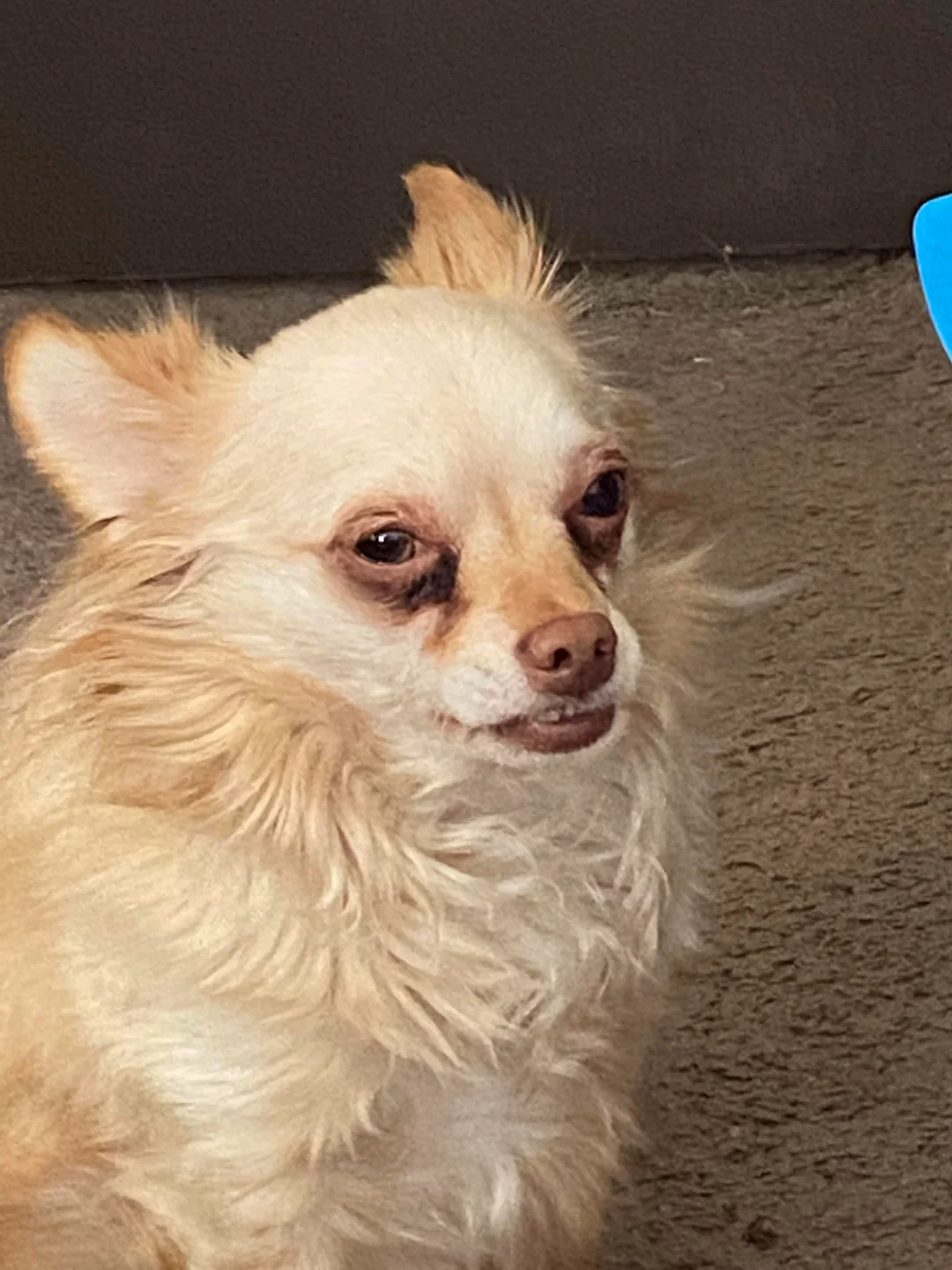
Chihuahua anxiety manifests differently in different dogs and across different anxiety levels. Learning to read the full spectrum — from subtle early signals to more obvious distress — is essential for early intervention. These are the most common signs:
Mild anxiety signals
- Lip licking or yawning out of context
- Whale eye (whites of the eyes visible)
- Panting without physical exertion or heat
- Displacement behaviours — sniffing the ground when nothing is there, sudden scratching
- Stiff body posture and tense facial expression
Moderate anxiety signals
- Trembling or shaking when not cold (one of the most recognisable signs of Chihuahua anxiety)
- Excessive barking or whining
- Clinginess — following the owner from room to room, refusing to be put down
- Hiding under furniture or in tight spaces
- Refusing food in unfamiliar environments or when anxious
Severe anxiety signals
- Fear-based aggression — snapping, biting, or growling when feeling cornered or threatened
- Destructive behaviour when left alone — chewing, scratching at doors
- Loss of bladder or bowel control during an anxiety episode
- Escape attempts from crates, rooms, or the garden
- Complete shutdown — refusing to move, eat, or engage
Most common causes of Chihuahua anxiety
Chihuahua anxiety almost always has an identifiable root cause. The most common are:
- Insufficient socialisation — the most common cause. A Chihuahua not positively exposed to different people, environments, sounds, and animals during the critical window (3 to 16 weeks) finds the world frightening and unpredictable as an adult
- Being carried rather than walking — Chihuahuas carried everywhere never develop the confidence that comes from meeting the world at ground level. They rely on the owner for safety rather than developing their own coping resources
- Separation anxiety — Chihuahuas form very strong attachments and are prone to distress when left alone. See our dedicated Chihuahua separation anxiety guide for specific solutions
- Inconsistent routine — Chihuahuas thrive on predictability. Unpredictable schedules, frequent changes in household members, or inconsistent rules all increase baseline anxiety
- Negative experiences — a frightening encounter with a large dog, a painful veterinary procedure without positive follow-up, or a traumatic event can create lasting anxiety around specific triggers
- Noise anxiety — particularly thunderstorms and fireworks. Chihuahuas’ small body mass means loud noises feel proportionally more intense than for larger dogs
- Medical causes — pain from dental disease, patellar luxation, or other conditions can manifest as anxiety. Sudden-onset anxiety in a previously calm dog always warrants a veterinary assessment
7 proven ways to calm Chihuahua anxiety
1. Build a predictable daily routine
Predictability is the most powerful environmental intervention for Chihuahua anxiety. A dog that knows exactly when walks happen, when meals are served, when alone time occurs, and what the daily structure looks like is significantly less anxious than one living in an unpredictable environment. Establish fixed times for feeding, walking, play, and rest — and maintain them consistently, including weekends. The reduction in baseline anxiety from routine alone is often dramatic.
2. Create a dedicated safe retreat
Every anxious Chihuahua needs a space that is entirely their own — somewhere they can retreat when overwhelmed and feel completely secure. A crate with comfortable bedding, a covered corner with familiar blankets, or a small-dog-only room serves this purpose. The retreat must never be used as punishment, must always be accessible voluntarily, and must never be invaded by other pets or people when the dog is using it. A Chihuahua that has a safe retreat manages anxiety significantly more effectively than one with no private space.
3. Socialise — gently and consistently
For dogs whose Chihuahua anxiety stems from under-socialisation, systematic positive exposure to previously frightening stimuli is the most effective long-term solution. This is not the same as flooding — forcing the dog into frightening situations. It is gradual, positive exposure at a distance and intensity below the anxiety threshold, paired with high-value rewards for calm behaviour. Progress is slow but durable. Every positive encounter with something previously frightening reduces the overall anxiety load.
4. Use counter-conditioning for specific triggers
Counter-conditioning changes the emotional association with a specific trigger — from threat to predictor of good things. For a Chihuahua anxious about strangers, the process involves: stranger appears at distance → dog receives a high-value treat → stranger leaves. Repeated over many sessions, the dog learns that a stranger predicts a treat rather than a threat. This is the most evidence-based approach for specific anxiety triggers and works across all forms of Chihuahua anxiety including noise, car travel, and veterinary procedures.
5. Allow ground-level exploration
One of the most important practical interventions for Chihuahua anxiety is stopping carrying the dog everywhere. A Chihuahua that encounters the world on their own four feet — walks on the pavement, meets new people at ground level, navigates new environments independently — builds genuine confidence and coping ability. A Chihuahua carried everywhere remains dependent on the owner for safety and never develops their own resources. Allow your Chihuahua to walk, explore, and encounter the world themselves.
6. Provide adequate exercise and mental stimulation
An under-exercised Chihuahua with pent-up energy is a more anxious Chihuahua. Daily exercise — 30 to 50 minutes across two walks — and daily mental stimulation significantly reduce baseline anxiety. Research from 2024 published in Nature Scientific Reports linked gut microbiome composition to anxiety and aggression in dogs, with diet and exercise patterns among the factors affecting microbiome health. A well-exercised, mentally stimulated Chihuahua with a healthy gut microbiome is physiologically primed for lower anxiety levels.
7. Consider evidence-based calming aids
For moderate to severe Chihuahua anxiety, several evidence-based aids can support behavioural intervention. Adaptil (dog-appeasing pheromone) diffusers and sprays have good research support for reducing anxiety in dogs. Anxiety wraps such as the Thundershirt apply gentle, continuous pressure that many dogs find calming — particularly for noise anxiety. Calming music (classical or reggae has the best research support for lowering canine heart rate and stress behaviours) can mask startling sounds. These aids work best as supplements to training and environmental management — not as standalone solutions.
Types of Chihuahua anxiety
Chihuahua anxiety is not a single condition — different types require different interventions:
- Separation anxiety — distress when left alone. The most common type in Chihuahuas. Requires gradual alone-time training from a very young age. See our full separation anxiety guide
- Fear-based anxiety — anxiety triggered by specific stimuli: strangers, children, other dogs, loud noises. Responds well to counter-conditioning and desensitisation
- Generalised anxiety — persistent low-level anxiety across many situations, often rooted in insufficient socialisation. Requires broad-based positive exposure and routine building
- Noise anxiety — specific fear of thunderstorms, fireworks, or other loud events. Responds to safe retreat creation, white noise masking, anxiety wraps, and Adaptil
- Social anxiety — anxiety around unfamiliar people or dogs. Most often rooted in under-socialisation; responds to gradual positive exposure at the dog’s own pace
Should you comfort an anxious Chihuahua?
Yes — comforting an anxious dog does not reinforce anxiety. This is one of the most persistent and damaging myths in dog training. Research consistently shows that providing calm reassurance helps the dog regulate their stress response rather than amplifying it. When your Chihuahua is anxious, remain calm yourself, lower your body posture to their level, speak in a low and steady voice, and provide gentle contact if the dog seeks it. Avoid high-pitched or excited reassurance (“it’s okay, it’s okay!”) which amplifies arousal rather than reducing it. The goal is calm, steady presence — not ignoring the dog or actively rewarding distress.
When to seek veterinary help for Chihuahua anxiety
Seek veterinary assessment for Chihuahua anxiety when: anxiety is severe enough to prevent normal daily function, the dog is injuring themselves or others during anxiety episodes, anxiety began suddenly in a previously calm dog (always rule out a medical cause), or when anxiety has not responded to consistent positive intervention over six to eight weeks. Your vet can rule out medical causes, refer to a clinical animal behaviourist, or in severe cases prescribe anxiety medication that significantly enhances the effectiveness of behavioural intervention.
At Chihuvas, our puppies leave with early socialisation built in — significantly reducing the likelihood of anxiety developing. Browse our available puppies or get in touch with our team. For related behaviour guides, see our posts on Chihuahua separation anxiety, Chihuahua biting, and Chihuahua training tips.
Common questions about Chihuahua anxiety
Start with a confident, well-socialised Chihuahua from Chihuvas.
Our puppies leave with early socialisation built in — the best foundation for a calm, confident adult dog. AKC-registered, Michigan’s most trusted Chihuahua breeder.
View available puppies →