
Chihuahua potty training — 7 proven steps for a mess-free home.
Chihuahua potty training has a reputation for being trickier than with larger breeds — and there is some truth to it, though not for the reasons most people assume. It is not that Chihuahuas are less intelligent or harder to train. It is that their small bladders and fast metabolisms mean they need to go more often than bigger dogs, and their tiny size makes an accident behind the sofa far easier to miss than the same accident from a sixty-pound dog. With the right schedule, the right method, and consistent patience, Chihuahua potty training is entirely achievable — most owners see solid progress within three to four weeks of starting a proper routine.
As AKC-registered Chihuahua breeders at Chihuvas, we begin gentle potty routine groundwork with every litter before they leave for their new homes. This guide covers the complete Chihuahua potty training process — the schedule by age, choosing between indoor and outdoor methods, recognising your puppy’s signals, and handling accidents the right way. Guidance draws on the AKC guide to house training a puppy and the PDSA puppy training guidance.
Potty training schedule by age
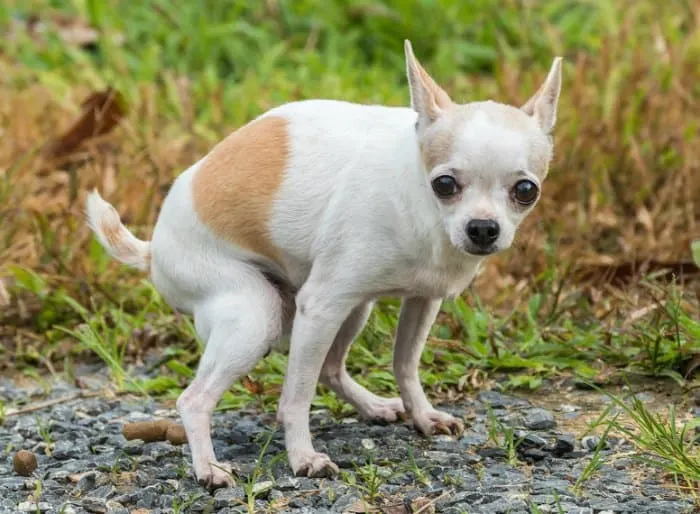
The most reliable rule of thumb for Chihuahua potty training is roughly one hour of bladder control per month of age. This gives a clear, practical schedule that scales naturally as your puppy matures:
| Puppy age | Maximum time between breaks |
|---|---|
| 2 months | Every 2 hours |
| 3 months | Every 3 hours |
| 4 months | Every 4 hours |
| 5 months | Every 5 hours |
| 6+ months | Up to 7–8 hours (with full training complete) |
Beyond this hourly guideline, always add extra potty breaks at key moments regardless of how recently the last one was: first thing in the morning after waking, immediately after meals, after any nap, after energetic play, and right before bedtime. These moments reliably trigger the need to go and are some of the most effective opportunities in all of Chihuahua potty training to catch success rather than an accident.
Indoor vs outdoor training
One of the first decisions in Chihuahua potty training is choosing between an indoor method (pee pads or a litter box) and outdoor training. Both work well — the right choice depends entirely on your living situation, not on which method is inherently superior:
- Indoor training (pee pads or litter box): well suited to apartment living, upstairs flats without easy outdoor access, or owners who cannot always get outside promptly throughout the day. Litter boxes are increasingly popular for toy breeds and can be more sanitary than pee pads, though both options work
- Outdoor training: well suited to homes with a secure, fenced garden where the puppy can be taken directly to a consistent designated spot
Avoid attempting to teach both methods simultaneously — this is too much for a young puppy to learn at once and tends to create confusion that slows overall Chihuahua potty training progress. Choose one approach, commit to it consistently, and only introduce the second method later if your circumstances genuinely require it.
7 proven steps for Chihuahua potty training
1. Choose one consistent spot
Whether indoor or outdoor, take your puppy to the exact same spot every single time. Familiarity and the lingering scent from previous successes help your Chihuahua quickly associate that specific location with going to the bathroom, which is one of the fastest ways to build reliable habits in Chihuahua potty training.
2. Use crate training as a complementary tool
Crate training works hand in hand with potty training because dogs naturally avoid soiling their own den. A properly introduced crate teaches your puppy to hold their bladder and bowels for short periods, supporting the development of genuine bladder control rather than relying on constant supervision alone. See our complete Chihuahua crate training guide for the full introduction process.
3. Use a consistent verbal cue
Choose a short, consistent phrase — “go potty,” “go pee,” or similar — and use it every single time you take your puppy to their spot. Repetition of the same cue at the same moment builds a clear association over time, eventually allowing the phrase itself to prompt the behaviour even before your puppy fully needs to go.
4. Reward success immediately and enthusiastically
The moment your Chihuahua finishes going in the right spot, reward immediately with a high-value treat and warm praise — using the same short celebratory phrase each time, such as “good potty!” This timing matters enormously in Chihuahua potty training: reward within a few seconds of the behaviour, not minutes later back inside, so the connection between the action and the reward is unmistakably clear.
5. Watch for the signals and act immediately
Every Chihuahua has subtle tells that signal an impending need to go — sniffing the ground intently, circling, sudden pausing during play, whining, or quietly slipping away to another room. Learning your individual puppy’s specific signals and responding to them immediately, rather than waiting, prevents the majority of avoidable accidents during the training period.
6. Never punish accidents
Chihuahuas are highly motivated to please but do not respond well to scolding or harsh correction — punishment creates fear and confusion rather than improvement, and can make a sensitive puppy genuinely afraid of the potty training process itself. If you catch an accident in progress, calmly interrupt and redirect to the correct spot without yelling. If you discover it after the fact, simply clean it up; there is no training value in scolding after the moment has passed.
7. Plan for when you cannot be home
Ideally you are present for most of the active Chihuahua potty training period, but realistically this is not always possible. For periods when you must be away longer than your puppy’s current bladder capacity allows, set up a small gated-off area or playpen containing water, a resting spot, and pee pads positioned away from food and bedding — rather than relying on extended crate confinement, which can become stressful over long periods.
Recognising the signals
Common signs your Chihuahua needs a potty break, in addition to the standard schedule:
- Sniffing the ground repeatedly and intently
- Circling in one spot
- Sudden pausing or stillness during play
- Whining or mild restlessness
- Wandering toward a door, the usual spot, or a quiet separate room
Acting on these signals immediately — rather than finishing what you are doing first — is one of the highest-leverage habits in successful Chihuahua potty training.
Handling accidents the right way
Accidents are a normal and expected part of Chihuahua potty training — even a puppy considered “trained” will have occasional slip-ups for months afterward. When one happens: never punish or scold, since this only creates fear and confusion. Clean the area thoroughly with an enzymatic cleaner specifically designed to break down the proteins in urine — regular household cleaners can leave behind a scent trace that draws your puppy back to the same spot to go again. Then simply continue the consistent routine without dwelling on the setback.
Realistic timeline expectations
With a good, consistent routine and full household cooperation, basic Chihuahua potty training can be achieved in 3 to 4 weeks. However, full reliability — including being able to hold for 7 to 8 hours alone — is often not complete until around 6 months of age, when bladder and bowel control have matured fully. Some individual Chihuahuas, particularly more independent or stubborn personalities, take longer and need extra patience. This is normal and not a sign that anything has gone wrong with the process.
Browse our available puppies or get in touch with our team for any questions about potty training your new Chihuahua. See also our complete Chihuahua puppy care guide for the first 30 days at home.
Common questions about Chihuahua potty training
Find a well-prepared Chihuahua puppy at Chihuvas.
Our puppies leave with early routine groundwork already begun — making potty training easier from day one. AKC-registered, Michigan’s most trusted Chihuahua breeder.
View available puppies →